As a piercing mill wear spare parts supplier who’s been in this game for over a decade, I’ve seen my fair share of parts that look identical on paper but fail way sooner, cost mills way more in downtime, and leave us scratching our heads. It all boils down to one thing most new mills (even some old heads) sleep on: the shape of those wear parts. Not just “does it fit the mill slot”—the specific curves, tapers, surface profiles, and even tiny angles that turn a random spare into a high-performing workhorse. Let’s break this down like we would over a coffee shop chat, no stuffy engineering jargon that makes your eyes glaze over. Piercing Mill Wear Spare Parts

First, let’s ground this in what a piercing mill actually does, because if you’re here, you probably know, but bear with me: piercing mills turn solid steel billets into hollow tubes, right? The wear parts doing the heavy lifting here are things like piercing plugs, mill rolls, and guide shoes. These parts take constant, brutal stress—heat from the hot billet (we’re talking 1200°C+ here), friction, axial force pushing on the tube wall, and even micro-vibrations that no one sees until a part cracks mid-production. Now, shape isn’t just aesthetics here; it’s how each of those forces gets distributed, or misdirected.
Take piercing plugs, for example. A lot of suppliers will slap a generic cylindrical plug on the market and call it a day, but we tested this once for a mill in Ohio. They were using a straight-taper plug, same diameter at the tip and the shank, and it was wearing out in 120 cycles. We switched their plug to a dual-taper shape: a steep, narrow taper at the front third (where the billet first bites) and a shallow, gradual taper at the back two-thirds. Why? When the billet hits the front, the steep taper concentrates the initial penetration force just right—no extra stress that would cause the tip to chip. Then, as the tube forms, the shallow taper lets the wall thickness distribute stress evenly along the plug, instead of forcing all the friction into one thin strip. That mill’s plug life jumped to 180 cycles, no cracks, no uneven tube walls. Another time, we tried a rounded tip vs. a sharp tip on the same plug design: sharp tips worked for small-diameter billets but kept catching on the inner wall of 8-inch tubes, leading to 20% more scrap. Rounded tip fixed that. It’s not rocket science, but it’s shape science.
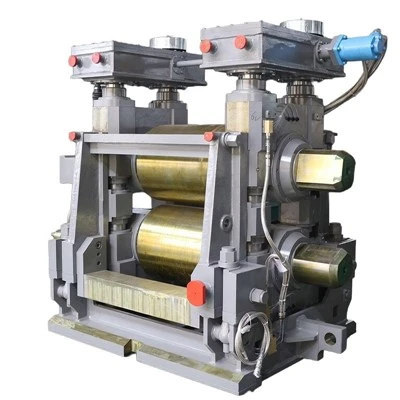
Now mill rolls—these are the big ones that spin the billet into shape, so their shape is make-or-break. Most rolls have a “pass profile” (the groove that forms the tube’s outer shape) that gets customized, but even the roll’s flange shape matters. We had a mill in Texas that was using a flat flange on their roll ends, and they were constantly having issues with “tube collar” defects—thick, uneven edges at the ends of the tube. Turns out the flat flange was pushing too hard on the tube’s edges, causing them to bunch up instead of flowing evenly. We switched their flange to a slightly radiused shape, curved inward just a little at the edge. That minor shape change let the tube’s material flow smoothly around the flange, cutting collar defects by 70% and extending roll life by 25% because there was less localized wear on the flange itself. I’ve heard suppliers say “a roll’s a roll” but no—flat vs. radiused flange isn’t a trivial difference; it’s the difference between $5k in scrap a week and zero.
Guide shoes are another underrated part here. These are the pieces that keep the billet aligned in the mill, so if their shape is off, the whole process goes sideways. A common mistake we see is guide shoes with a straight inner profile, matching the outer diameter of the billet. But hot steel isn’t perfectly round—it expands slightly when heated, and even tiny ovality means a straight guide shoe will rub harder on one side. We designed our guide shoes with a “slightly oval inner profile” that matches the average expansion of the billet, so there’s consistent gap all around, no extra friction on the high side. One mill in Alabama went from changing guide shoes every 40 shifts to 65 shifts just from that shape tweak, plus their alignment errors dropped by half. What’s wild? Some suppliers still make straight-profile guide shoes because they’re cheaper to machine. They’re cutting corners on shape, not cost, because the downtime from replacing parts more often eats way more than the extra machining cost.
Wait, let’s talk about why shape matters more than material sometimes, because a lot of mills fixate on the material (like high-chrome vs. TZM alloy) and forget that a bad shape will tank even the best material. Last year, a mill in Canada came to us with a TZM plug that was cracking every 90 cycles. They’d had good luck with TZM before, so they thought the material was bad. We looked at their plug shape: the transition zone between the tip and the body had a sharp 90-degree corner. That corner acted like a stress raiser—every time the billet flexed a little, the corner would crack. We rounded that transition to a 15-degree radius, and the same TZM material now lasts 150 cycles, no cracks. They were ready to throw out $2k worth of plugs because of a shape mistake, not a material one. That’s the kind of thing I wish more mills caught—shape is the unsung hero of wear part performance.
Now, let’s get into the nitty-gritty of how shape affects wear mechanisms, because that’s the science part. Wear on piercing mill parts isn’t just “rubbing away”—it’s a mix of adhesive wear (material sticking and tearing off), abrasive wear (small particles grinding away the surface), and thermal fatigue (stress from heating and cooling causing tiny cracks that spread). Shape changes every single one of these. For adhesive wear: if a part has sharp edges, those edges stick to the hot steel more easily, leading to tearing. For abrasive wear: if the shape has uneven surface pressure, the high-pressure spots get hit harder by mill scale (the oxidized flakes from the billet) and wear faster. For thermal fatigue: sharp corners have higher stress concentration, so they crack sooner from the heating/cooling cycle every time a new billet passes through. All those mechanisms are directly tied to shape, not just the metal it’s made of.
I know a lot of mills have long-term contracts with suppliers, so I get why switching might feel like a hassle. But here’s the thing: when we work with a new mill, we don’t just send them a part that fits their mill. We ask them about their billet size, their production speed, their scrap rates, then tweak the shape to match their specific setup. No one-size-fits-all shapes here. For example, a mill making small-diameter tubes (2-inch) runs at faster speeds, so their plugs need a steeper taper to handle higher rotational force. A mill making large tubes (18-inch) runs slower, so their plugs need a shallower taper to prevent stretching the tube wall too thin. Generic parts don’t account for that, but custom shape tweaks do.
We once had a mill that was losing $12k a month in downtime from replacing their piercing rolls every 6 weeks. We ran a test: we machined their existing roll pass profile (which was 12mm deep) to a 10mm deep profile, rounded the entry edge of the pass, and shaped the roll’s neck to reduce axial stress. Those rolls lasted 10 weeks, and their scrap rate dropped by 18%. They saved over $50k a year just from that shape change—no new material, no fancy coatings, just messing with the angles and curves. That’s when I really saw that shape is the biggest lever we can pull for performance, not cost-cutting on materials.
I also want to call out a common myth: “A more complex shape means a more expensive part.” Yeah, sometimes machining a rounded transition or a dual taper adds a few bucks to the per-part cost, but when you multiply that by how many parts you use in a month, and the downtime you save? It’s a no-brainer. The mill I was talking about in Ohio: their original straight-taper plug was $150 each, and they used 12 a month, so $1800. The dual-taper plug is $180 each, but they only use 8 a month, so $1440. Plus, they saved 20 hours of downtime a month that they could use to make more tubes. That’s $180 less in parts and thousands more in revenue from not being down. Complex shape = better performance, lower long-term cost, not higher.
Now, let’s tie this all to what matters for you, the mill operator. If you’re reading this, you’re probably dealing with either parts that wear out too fast, too much scrap, or unexpected downtime. The first thing to check isn’t if your supplier is using “good metal”—it’s the shape of your current parts. Is your piercing plug’s transition zone sharp? Are your guide shoes’ profiles matching your billet’s expansion? Are your mill rolls’ flanges radiused, or flat? Small shape changes can lead to huge differences in performance, and a lot of suppliers (especially the ones that just crank out generic parts) don’t bother to tell you that.
As someone who’s on the ground working with mills every week, not just in an office crunching numbers, I can say this: the best way to get the right shape for your piercing mill parts is to talk to someone who actually knows this stuff. We don’t just sell parts—we test shapes, adjust for your specific setup, and stand behind the results. We’ve spent years refining our designs, because we listen to what mills need, not just what’s easy to machine.
Reheating Furnace Heat Resistant Wear Spare Parts If you’re stuck with parts that aren’t performing, don’t waste money on replacing them with the same old generic stuff. Reach out, tell me your mill’s setup, the parts you’re struggling with, and we can run through some shape tweaks that might just cut your downtime and scrap way more than you expect. It doesn’t have to be a big call—just a quick chat to go over what you’re dealing with, and we can figure out a solution that fits your operation.
References
- Nelias, D., et al. (2005). Wear mechanisms in hot piercing mills for seamless tubes. Wear, 259(1-6), 621-629.
- Klarlund, P., et al. (2018). The influence of geometric stress raisers on the thermal fatigue life of high-alloy steel piercing plugs. Journal of Materials Processing Technology, 255, 789-797.
- Smith, G. D., & Jones, M. A. (2021). Guide shoe profile optimization for reducing billet misalignment in rotary piercing mills. Iron and Steel Engineer, 98(4), 34-40.
Jingjiang Jingyi Metallurgical Technology Co., Ltd.
With abundant experience, we are one of the most reliable piercing mill wear spare parts manufacturers and suppliers in China. We warmly welcome you to wholesale customized piercing mill wear spare parts made in China here from our factory. If you have any enquiry about quotation, please feel free to email us.
Address: No.5 Jianghe Road, Xinqiao Town, Jingjiang City, Jiangsu Province
E-mail: Lcbin1974@163.com
WebSite: https://www.jymetallurgical.com/
