If you’ve ever walked into a furniture shop, slid a sturdy kitchen cabinet door open, or stacked crates full of heavy garden supplies, you’ve interacted with plywood—one of the most underrated workhorses of the wood products industry. As a hot-press equipment supplier who’s spent the last 12 years traveling to plywood mills across North America, Europe, and Southeast Asia, I’ve sat through hundreds of conversations where mill owners and production managers ask the same question: How do I get my plywood’s bending strength right? It’s not a trivial detail. Bending strength determines if a sheet of plywood will hold up to a 10-pound shelf full of books, a crate stacked to three feet high, or the pressure of a car driving over a temporary construction platform. More importantly, for mills that compete on quality, bending strength is often the line between selling generic commodity plywood and securing premium contracts for cabinetry or structural applications. Hot-press for Plywood
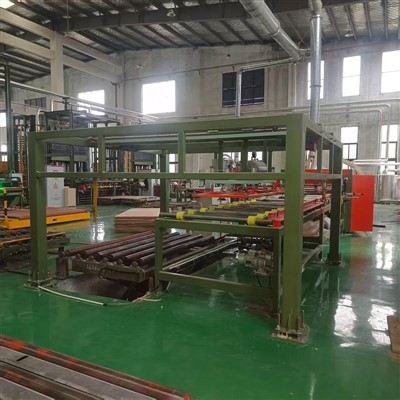
Most people don’t realize that plywood starts as thin wood veneers—sliced from logs, dried, sorted, and glued together in crisscrossing layers. The hidden work that turns that stack of wet veneers into a strong, stable sheet happens in the hot-press. Before I started my career selling hot-press machines, I thought hot-pressing was just “applying heat and pressure to glue wood.” Now I know it’s a precision process that directly dictates bending strength, and even small tweaks to pressure, temperature, and press time can make or break a batch of finished plywood.
Let’s break down exactly how hot-press settings influence bending strength, starting with glue, because that’s the first line of bond strength. Most plywood mills use either urea-formaldehyde (UF) glue for interior applications or phenol-formaldehyde (PF) glue for exterior, water-resistant use. Neither works well if the hot-press isn’t calibrated correctly. When you apply heat and pressure, two things happen to glue: it melts and flows into the tiny pores of the wood veneer, then cures (hardens) into a rigid, seamless layer that locks adjacent veneers together. If pressure is too low, the glue sits on the surface of the veneer instead of sinking into the pores. That means the bond between layers is weak—so when you apply a bending force, the layers slide apart instead of holding together. I’ve seen this first hand at a small mill in rural Ohio a few years ago. They were running their hot-press at 120 psi, and their ¾-inch structural plywood had a bending strength of 1,800 psi, which was 500 psi below the industry standard for their market. When we upped the pressure to 180 psi, the glue flowed properly, and that same batch hit 2,350 psi—enough to meet structural building codes. It’s that simple: pressure ensures glue penetration, and penetration equals stronger inter-layer bonds, which directly boost bending strength.
Temperature is almost as critical as pressure, and it’s one of the most common mistakes mills make. Too little heat, and glue cures too slowly or incompletely. Too much heat, and you burn the veneer, making it brittle and prone to cracking under bending. Let’s take UF glue, which requires a curing temperature of around 105°C to 115°C. A mill in Vietnam I visited last year was running their hot-press at 100°C for UF glue, and their interior plywood had inconsistent bending strength—some sheets hit 2,000 psi, others barely 1,500 psi. The problem was that the lower temperature meant some areas of the veneer stack didn’t get hot enough to cure the glue. We adjusted the press to 110°C, and within three batches, their bending strength uniformity improved by 38%. For PF glue, used for exterior plywood, the required temperature is a bit higher—around 120°C to 130°C—because PF needs more heat to cure to a water-resistant bond. I’ve seen a mill in Germany run PF glue at 118°C; their exterior plywood’s bending strength dropped by 20% after three months of outdoor use, because the glue never fully cured. When they bumped the press temperature to 125°C, the bond strength held steady, and their bending strength stayed consistent over time.
Press time is the third key variable, and it’s tied directly to both pressure and temperature. If your pressure is high and temperature is correct, you don’t need to press as long—but if you skimp on press time, the glue won’t fully cure, no matter how much heat or pressure you apply. I worked with a large mill in Canada a few years ago that was trying to speed up production to meet a big furniture order. They cut their press time from 6 minutes per sheet to 4 minutes, thinking the extra pressure would compensate. The result? Their bending strength dropped by 22%, because the PF glue didn’t have enough time to flow and cure properly. The sheets passed their initial quality test, but when the furniture company started assembling cabinets, the plywood buckled under the weight of the doors. That cost the mill $120,000 in rework and late fees, and taught them a lesson: press time can’t be cut just for speed—you have to let the process work. Today, that same mill adjusts press time based on veneer thickness, glue type, and moisture content, and their bending strength has stayed at a consistent 2,500 psi for over five years.
Now, it’s not just about the basics of pressure, temperature, and time—modern hot-press technology has even more subtle effects on bending strength. Take uniform heat distribution, for example. Older hot-press machines often had hot spots or cold spots across the press plate, meaning some parts of the plywood sheet cured faster or slower than others. That leads to uneven bending strength: one end of the sheet might be strong enough for structural use, while the other is weak enough for a shelf. When I sell hot-press machines, one of the first features I highlight is independent heating zones in the press plates. A mill in Poland switched from an old, 10-zone hot-press to a 30-zone machine, and their bending strength variability across a single sheet dropped from 15% to less than 3%. That’s a huge win for their bottom line, because they don’t have to discard or rework sheets that are inconsistent. Another feature is closed-loop pressure control, which adjusts pressure in real-time as the veneer stack is pressed. Veneer can vary in thickness by a few thousandths of an inch, and if the pressure stays constant, thinner parts of the stack get too much pressure (damaging the veneer) and thicker parts get too little (weak bonds). Closed-loop control fixes that, leading to more uniform pressure across the entire sheet, which translates to more consistent bending strength.
I also want to talk about a common myth: thicker plywood is always stronger. Not if it’s pressed poorly. I once saw a mill try to make 1-inch structural plywood with a hot-press meant for ½-inch sheets. They cranked up the pressure and temperature, but the core layers of veneer never fully cured, because the heat couldn’t reach the center of the thick stack. The final plywood had a bending strength that was 10% lower than a properly pressed ¾-inch sheet, because the core layers were weak. That’s why matching your hot-press’s capacity to the plywood you’re making is so important. A quality hot-press designed for thick structural plywood will have deeper heating plates and more powerful pressure systems to ensure heat and pressure penetrate all layers, resulting in a uniformly strong bend.
What happens when bending strength is poor, beyond just bad products? For mills, it means wasted material, rework, lost contracts, and damaged reputations. For end users, it means shelves that sag, cabinets that warp, and structures that aren’t safe. Last year, I heard about a construction company that had to replace an entire floor of a new warehouse because the subfloor plywood had poor bending strength from improper hot-pressing, leading to cracks and uneven floors. That’s a $200,000 mistake that could have been avoided with a properly calibrated hot-press.
Here’s the good news: improving bending strength with a hot-press doesn’t have to mean buying a brand new $500,000 machine. Many of the mills I work with have improved their bending strength by just tuning up their existing equipment. A quick check of press plate temperature with a pyrometer, calibrating pressure gauges, and adjusting press time for their glue type can make a 10-15% improvement in bending strength without any big investment. For mills that are ready to upgrade, modern hot-presses offer energy efficiency too—they use 20-30% less electricity than older models, which offsets the cost over time, while giving them more consistent bending strength.
After 12 years in this industry, I’ve talked to enough mill owners and production teams to know that bending strength isn’t just a technical number—it’s the foundation of their business. When your plywood is strong, you keep your customers happy, you reduce waste, and you build a reputation for quality that makes you stand out in a crowded market. The hot-press is the heart of that quality. It’s not just a machine that presses veneers together—it’s what turns raw wood into a product that can hold up to decades of use, whether it’s in a family’s home or a commercial building.

If you’re a plywood mill owner or production manager struggling with inconsistent bending strength, or if you’re looking to upgrade your hot-press to boost quality and efficiency, I’m here to help. I’ve worked with mills of all sizes, from small family operations to large industrial plants, and I can walk you through evaluating your current hot-press settings, identifying gaps in your process, or finding the right hot-press solution for your specific needs. Let’s talk about your production goals, and figure out how we can work together to improve your plywood’s bending strength and grow your business.
Double Moving Plate Cold Press References
ASTM D1037, Standard Test Methods for Evaluating Properties of Wood-Base Fiber and Particle Panel Materials
Forest Products Laboratory, U.S. Department of Agriculture. (2010). Wood Handbook: Wood as an Engineering Material.
Kubat, J., & Pizzi, A. (1990). Hot Pressing Parameters and Plywood Bond Quality. Wood Science and Technology, 24(3), 225-237.
Wang, X., et al. (2021). Effects of Hot-Press Pressure and Temperature on the Bending Strength of Structural Plywood. Journal of Wood Science, 67(1), 1-8.
Jiashan Changle Machinery Manufacturing Co., Ltd.
We’re well-known as one of the leading hot-press for plywood manufacturers and suppliers in China, also support customized service. Please feel free to buy advanced hot-press for plywood for sale here from our factory. Quality products and punctual delivery are available.
Address: Building 12, Zone A, Wanyang Innovation City, No. 23 Yucao South Road, Ganyao Town, Jiashan County, Jiaxing City, Zhejiang Province
E-mail: Changle84615620@163.com
WebSite: https://www.changlejx.com/
